VW’s Hybrid Bet: Atlas, Cross Sport, and Tiguan Going Full Hybrid by Decade’s End

Photo by Michael Fousert on Unsplash
Volkswagen just quietly announced one of the most sensible hedging strategies in the industry—and nobody’s calling it bold enough. While competitors are either racing toward EV-only futures or hedging their bets with mild hybrids, VW is doubling down on full hybrids across its three biggest volume sellers in America. That’s not caution. That’s pragmatism.
At the New York auto show, VW Group of America CEO Kjell Gruner confirmed that the newly unveiled 2027 Atlas will get a hybrid variant, but more importantly, he revealed the scope: the Tiguan and a redesigned Atlas Cross Sport will also join the party with identical powertrains. Three models. Three full hybrids. One clear message: VW thinks the future is messier than anyone wants to admit.
The Atlas Hybrid Offensive Takes Shape
The 2027 Atlas launches with VW’s evolved turbocharged 2.0-liter four-cylinder—a competent engine, nothing revolutionary. But that’s just the opening act. Gruner confirmed the hybrid version will arrive during the mid-cycle refresh, which means we’re looking at roughly 2029 for market availability. That’s longer than VW would prefer, but there’s actual logic behind the wait.
“The hybrid needs to be U.S.-specific,” Gruner explained. “There’s nothing on the shelf that we can just take because of the requirements of the U.S. market.” Translation: VW isn’t rebadging some German or Chinese hybrid setup. They’re engineering and manufacturing this thing domestically, which means rebuilding supply chains from the battery pack up through the gearbox. It’s slower, but it’s also way harder for competitors to copy.
The Atlas family moved 102,608 units in 2025—roughly 70 percent three-row Atlas, 30 percent two-row Cross Sport. Those numbers matter because they justify the investment. This isn’t niche-market thinking; this is volume-play thinking.
The Atlas Cross Sport Gets Its Own Generation
Here’s where VW stops playing it safe: the Atlas Cross Sport isn’t just getting a hybrid powertrain, it’s getting an entirely new generation. Gruner confirmed it’ll arrive in 2027-2028 timeframe—”not two years,” he said when pushed on timing—which tracks as a 2028 model year reveal.
The new Cross Sport follows the same philosophy as today’s version: same wheelbase as the three-row Atlas, but shorter overall with a more aggressive, sloping roofline and strictly two-row seating. It’s the coupe-SUV play without the useless third row. And yes, it’ll get the full hybrid treatment alongside the standard turbo four.
That matters because the Cross Sport has real sales legs. Nearly 31,000 units last year alone. That’s enough volume to justify tooling up an entirely new generation, and enough volume to make the hybrid variant worth engineering properly.
The Tiguan Hybrid: The Third Pillar
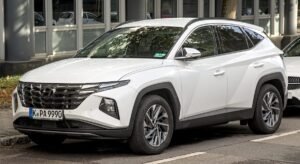
The real surprise is the Tiguan. VW moved 78,621 Tiguans in the U.S. last year—strong numbers even as the brand transitioned to its latest generation. It’s a no-brainer candidate for a hybrid powertrain, but until Gruner’s confirmation at the auto show, it wasn’t official.
The Tiguan Hybrid will use the same full-hybrid setup as the Atlas and Cross Sport, arriving around the same 2029 window. VW is treating all three vehicles as a unified platform play, which is actually smart—shared powertrain development across three volume models kills per-unit engineering costs.
The Tiguan hybrid timing is crucial. The compact SUV segment is where real volume lives in America. Honda’s CR-V Hybrid, Toyota’s RAV4 Hybrid, and Mazda’s CX-50 PHEV are all eating lunch in that space. VW needed to show up with actual firepower, not some half-baked eco variant.
Why Full Hybrid, Not Plug-In?
Gruner was explicit about one thing: traditional full hybrids only. No plug-in hybrids. The reasoning is airtight: PHEV demand in the U.S. market is anemic, the added complexity and battery weight inflate costs, and the real-world efficiency gains don’t justify the price premium. VW looked at the data and made the call most executives are too scared to make publicly.
It’s the same calculus Toyota made years ago. Just build the best regular hybrid you can, make it cheaper than the alternative, and let the customer math sell itself. PHEVs are a technology for optimists and California subsidies. Full hybrids are for people who actually want to save fuel without the complexity.
The Bigger Play: Hedging Against Uncertainty
Step back and look at what VW is actually saying here: “We will have internal combustion, full hybrid, and EVs.” That’s not a company betting everything on one future. That’s a company that looked at the EV transition timeline, the grid realities, the charging infrastructure, and decided to build a portfolio that works whether the future is 2035, 2040, or slower.
It’s the most reasonable thing anyone in this industry has said in years, and it’ll probably get zero credit for it. Investors want purity—either all-in EV or stubborn ice-only. A diversified approach that acknowledges real-world complexity? That doesn’t move stock prices.
But it sells cars. And right now, selling cars to actual customers—not the board of directors—is looking pretty smart.
Frequently Asked Questions
When will the 2027 Atlas Hybrid arrive?
VW expects the Atlas Hybrid to launch around 2029 as part of a mid-cycle refresh. The delay is intentional—the company is engineering a U.S.-specific hybrid powertrain and building domestic supply chains from scratch rather than importing an existing platform.
Will the new Atlas Cross Sport be a three-row SUV?
No. The second-generation Cross Sport will remain strictly two-row with a more aggressive, sloping roofline. It shares the wheelbase with the three-row Atlas but sacrifices the third row for a sleeker profile and coupe-like styling.
What type of hybrid system will VW use?
All three vehicles—Atlas, Cross Sport, and Tiguan—will use traditional full-hybrid technology, not plug-in hybrids. VW rejected the PHEV route due to weak market demand, added weight, higher costs, and the complexity of maintaining separate powertrains.
How many Tiguans and Atlas models did VW sell in 2025?
VW sold 102,608 Atlas units (including Cross Sport) and 78,621 Tiguans in the U.S. during 2025, with the three-row Atlas accounting for about 70 percent of family sales and the Cross Sport roughly 30 percent.
Via RevFeed Archive — Original article
- VW will launch full hybrids for the Atlas, Atlas Cross Sport, and Tiguan by late this decade—three new models, not one.
- The second-gen Atlas Cross Sport arrives around 2027-2028 as a two-row alternative to the three-row Atlas.
- All hybrids are U.S.-specific builds with domestic supply chains; expect the Atlas Hybrid around 2029.
- VW is skipping plug-in hybrids entirely due to cost, weight, and weak market demand.