Ferrari’s HC25 Is a $3 Million Love Letter to the Non-Hybrid V-8
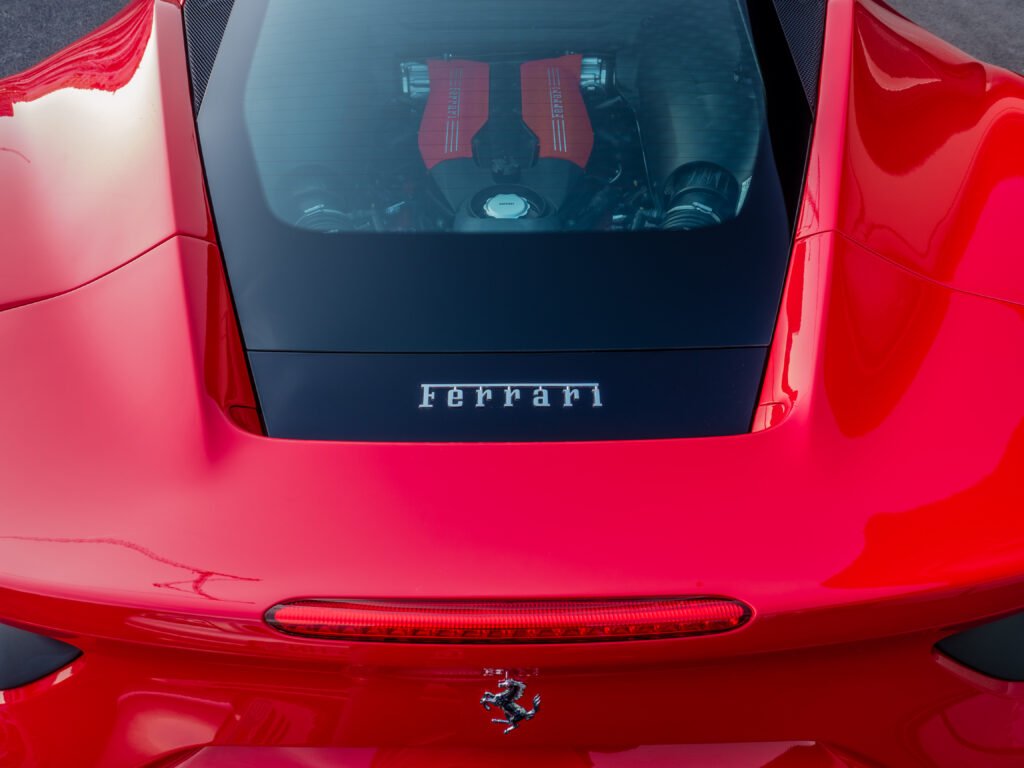
Ferrari just proved that designing a supercar for the ultra-wealthy doesn’t require a single kilowatt-hour of battery power. The HC25, the latest commission from the Maranello brand’s notorious Special Projects division, is a bespoke, one-off machine that wears tomorrow’s styling language while clinging to yesterday’s powerplant—and it absolutely owns that contradiction.
Based on the now-discontinued F8 Spider platform, the HC25 reinterprets Ferrari’s mid-rear-engined DNA for a single unnamed customer who clearly had one job: make it look like the future, but keep the V-8 screaming like the past. Mission accomplished.
Design That Actually Turns Heads
Here’s where the HC25 separates itself from the F8 it’s based on: the bodywork is entirely custom, and it borrows heavily from Ferrari’s latest design vocabulary. If you squint at the aggressive LED headlights with their vertical daytime running light cascade, you’ll catch hints of the F80 flagship—Ferrari’s statement piece that proves the brand still knows how to make jaws drop. The front fascia sports a black trim piece sandwiched between those slim headlights, giving the car a surgically modern face that would look equally at home in a concept gallery or a hypercar showroom.
But the real signature move is that horizontal black band. It wraps around the entire car, starting from the engine cover and slicing the HC25 into two distinct visual sections. That band isn’t just for show—it houses air intakes that feed the V-8 and ducts that extract heat from the engine bay. Nestled within it is an aluminum blade milled from solid stock that doubles as the door handle. It’s functional art, the kind of detail that costs money but looks like it shouldn’t exist at all.
Dimensionally, Ferrari stretched the design just enough: the HC25 is 147 mm longer, 27 mm wider, and 23 mm lower than the standard F8. The proportions are visibly better for it. Out back, ultra-slim quad LED taillights nest into the air vents, flanked by an aggressive diffuser and dual tailpipes. The whole thing wears matte Moonlight gray with gloss black accents and hints of yellow—a color choice that carries through to the brake calipers and interior detailing. The wheels are bespoke 20-inch five-spokes with diamond-cut finishing.
The Interior: Ferrari Kept It Simple
Inside, Ferrari didn’t reinvent the dashboard for one customer—and honestly, why would they? The HC25 carries over the fundamental cabin architecture from the F8 Spider, but with custom upholstery that mixes leather and fabric. The boomerang-shaped yellow accents on the seat backs and bottoms, paired with yellow stitching across the bolsters and dashboard, tie the interior to the exterior’s color story. It’s restrained customization—letting the driver focus on the machine rather than fighting flashy trim.
The Engine: Non-Hybrid, Non-Negotiable
This is where the HC25 makes its real statement. While much of the automotive world rushes toward electrification, Ferrari handed its customer the last non-electrified V-8 the F8 platform ever produced—and that matters.
The powerplant is a twin-turbocharged 3.9-liter V-8 producing 710 horsepower and 568 pound-feet of torque, routed to the rear wheels through a seven-speed dual-clutch automatic. No hybrid assist. No battery pack hiding weight in the frame. Just raw, analog combustion sent straight to the pavement. Ferrari claims the HC25 will rip to 62 mph in 2.9 seconds, hit 124 mph in 8.2 seconds, and max out at 211 mph. Those numbers aren’t revolutionary anymore—plenty of machines hit them. But the lack of any electrical motivation in 2025 is becoming genuinely rare.
This is Ferrari’s last F8-based Special Project, following the SP49 Unica from 2022 and the SP-8 roadster from 2023. The customer was clearly betting that stripping out hybrid complexity and batteries while upgrading the visual drama would age better than a tech-packed spec sheet. Time will tell if they’re right, but the philosophy is refreshingly contrarian in an industry obsessed with digital maximalism.
What This Says About Ferrari’s Future
The HC25 exists in a weird philosophical space: its design hints at where Ferrari’s styling is heading—sleeker, more geometric, borrowing cues from the F80 and 12Cilindri—while its powertrain is a final victory lap for the internal combustion engine. It’s a bridge car, essentially. A one-off commissioned by someone with enough money to say “I want your newest design language, but give me your last pure V-8.”
That level of customization comes at a cost Ferrari never publicly discloses. Based on comparable Special Projects commissions and the bespoke work involved, you’re probably looking at eight figures—somewhere in the $3-5 million range—but that’s educated guessing. What matters is that someone just paid Ferrari’s design studio a blank check to prove that the non-hybrid V-8 supercar still has a heartbeat.
The HC25 is exactly what Ferrari’s Special Projects division exists to do: indulge the impossible desires of the impossibly wealthy. But it also serves as a quiet middle finger to anyone declaring the V-8 officially dead. This car isn’t a production model. It won’t save the naturally aspirated engine. But it’s proof that for one customer, at least, the future can wait another few years.
- Ferrari’s HC25 is a one-off Special Projects supercar based on the F8 Spider with entirely custom bodywork and futuristic styling cues from the F80.
- It’s powered by a non-hybrid twin-turbo 3.9L V-8 making 710 hp, hitting 62 mph in 2.9 seconds with no battery assist.
- Price undisclosed, but likely $3-5 million; it’s the last F8-based one-off and proves the pure V-8 supercar still has patrons.
Sources: Car and Driver · Carscoops · Autoblog · Motor1