
This Digital Alfa Romeo GT Restomod Proves the Purists Wrong
The Alfa Romeo GT was never supposed to matter this much. Built from 2003 to 2010 as the coupe sibling to the 147 and 156, it arrived too late in Alfa’s Bertone era and died before anyone fully appreciated what the Italian design house had accomplished. But cheap used examples and that gloriously naturally-aspirated 3.2-liter Busso V6 have made it a cult object among the faithful—and now one designer has dared to ask what it could have been.
The result is a digital restomod that swaps in design language from Alfa’s golden age of the 1960s and ’70s, pairs it with a thoroughly modern chassis, and somehow manages to convince 83% of surveyed Alfisti that the blasphemy actually works. Whether you land there depends almost entirely on your tolerance for round headlights.
The Case for Nostalgia
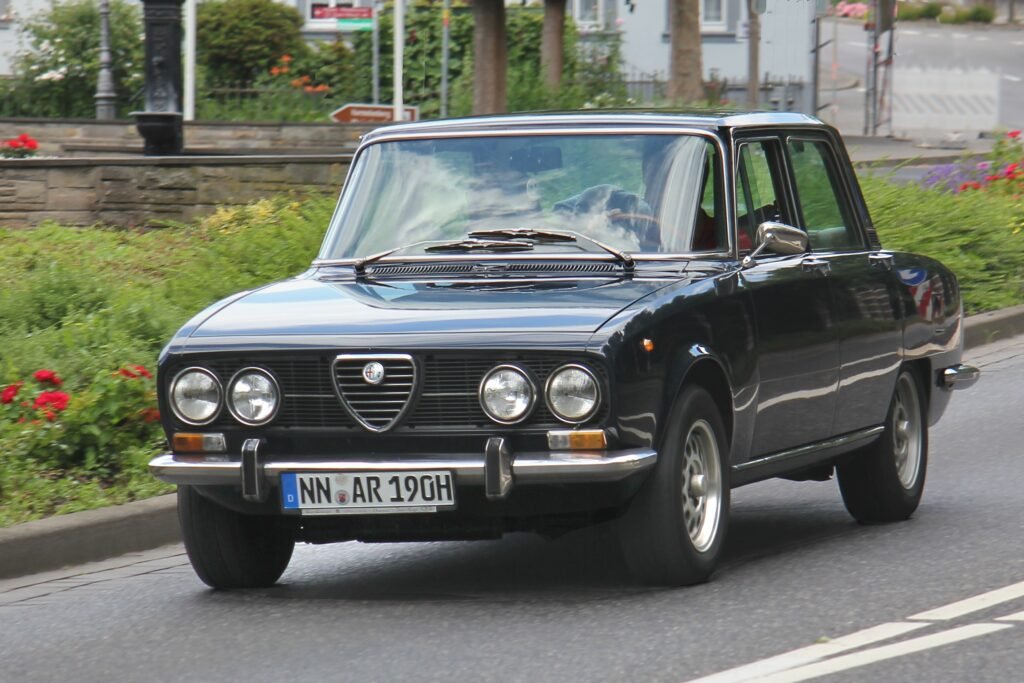
The redesigned front end is where this concept lives or dies. Instead of the GT’s original swept headlights, the restomod borrows the iconic round units from classics like the Giulia Sprint GT and 1750 GT Veloce. They’re fed by massive air intakes framed by a larger scudetto grille, all wrapped in a new hood with aggressive creasing that echoes the Brera and 159. It’s a bold gamble—trading Bertone’s clean, understated elegance for a more aggressive, heritage-soaked persona.
The rest of the profile remains untouched. The greenhouse, roof structure, pillars, mirrors, and doors carry over exactly as Bertone penned them. But everything below gets wider: broader front and rear fenders, bigger wheels, and a dropped stance that the factory never dared attempt. The rear end pulls inspiration from the Giulia GTAm, complete with a sculpted bumper, carbon fiber diffuser, and quad tailpipes. The taillights get modern LED graphics that respect the original glass shape without pretending to be stock.
It’s a masterclass in restraint, really. There’s no spoiler wing—the original rear glass and clean Bertone surfaces do the work. That kind of discipline separates a proper restomod from the usual widebody disaster.
The Engine That Never Left
Under the hood sits the irreplaceable Busso V6, a naturally-aspirated 3.2-liter engine that produced 237 horsepower in stock trim. In the concept, modest tuning—forged pistons, a bored-out displacement to 3.7 liters, wilder camshafts, and Ferrari-derived throttle bodies—could push it past 300 hp without forced induction.
A supercharger would be overkill. The real upgrades happen lower: a limited-slip differential, coilovers, wider tracks, and brakes lifted from the Intensa and Quadrifoglio versions of the modern Giulia sedan. The six-speed manual and front-wheel-drive architecture inherited from the 147 and 156 GTA remain untouched, which means there’s genuine dynamic potential here—not just visual theater.
The exhaust note already borders on glorious stock. A custom system would push it into genuinely memorable territory. This isn’t a car crying for electric motors or twin-turbos. It’s a car that just needed to be taken seriously.
The Purist Question
To test-drive this concept in the court of actual opinion, the designer presented it to Alfisti at the Museo Alfa Romeo during the brand’s June 21st birthday celebration. The verdict was split—but not the way purists expected.
Of 30 Alfa Romeo owners surveyed, 25 praised the project, appreciating the historical nods baked into every surface. Five remained unconvinced, preferring the original Bertone lines untouched. The main complaint? The round headlights don’t sit right on a profile that Bertone drew for something sleeker and more modern.
Some argued for slimmer units in the spirit of the Pininfarina 2uettottanta roadster, which would echo the horizontal taillights and calm the front end considerably. That’s a fair critique—and it reveals something important about restomod design: the smallest details can either feel like clever historical rhyming or like you’re just bolting old parts onto new cars.
The Uncomfortable Economics
Here’s where fantasy crashes into reality. A full conversion covering exterior, interior, and underpinnings would easily exceed €50,000 ($55,000)—before you even buy the donor car. On the used market, a decent Busso V6 GT runs for pocket change compared to that.
This introduces a brutal paradox: the GT is so cheap to acquire that it’s impossible to justify spending several multiples of its value on modifications. Even so, as a limited-production model aimed at collectors, it could work. Among the 80,832 Alfa Romeo GTs ever built, there’s surely a handful of genuinely unhinged enthusiasts willing to spend the money for a one-off.
The designer has reportedly begun talking to companies about turning this from rendering into reality. That’s the move that separates a design study from an actual business. Because if there’s one thing Alfa’s purists have proven, it’s that they’ll pay for something that respects the marque’s DNA while daring to push it forward.
The Real Verdict
This restomod works because it doesn’t fake humility. It takes an honestly elegant car and makes it more purposeful without apologizing. The round headlights will divide opinion forever—that’s the cost of being interesting—but the proportions, the stance, the engineering underneath, and the respect for Bertone’s original shape all land.
The Alfa Romeo GT was built in an era when the company was running on fumes, when every decision had to justify itself to accountants rather than dreamers. This concept imagines what might have happened if Alfa had one more shot, one more budget, and the courage to lean into its own legend. Whether you’d actually buy one is a different question. But wanting to? That’s completely rational.
- A designer reimagined the Alfa Romeo GT (2003-2010) with classic round headlights, wider fenders, and a modern suspension setup inspired by the Giulia.
- The stock 3.2-liter Busso V6 produces 237 hp; the concept suggests tuning it past 300 hp while keeping it naturally-aspirated.
- Of 30 Alfisti surveyed at the Museo Alfa Romeo, 25 approved the design; five preferred the original Bertone lines untouched.
- A full restomod conversion would cost €50,000+ ($55,000+) before the price of the donor car, making it viable only as a limited-production collector’s piece.
Sources: Carscoops