Lexus’s Three-Row EV Uses the LFA’s Fake V10 Sound. It Actually Earns It.
Lexus just dropped the TZ, a three-row electric SUV that’s basically a more expensive, better-equipped version of Toyota’s bZ Highlander—but with one genuinely weird party trick: it can mimic the engine sound of a supercar that costs three times as much.
A Spindle Grille on Wheels
The 2027 Lexus TZ arrives as Lexus’s first proper family hauler in the EV space, sitting above the smaller RZ in the lineup. It’s nearly identical in bones to the Toyota bZ Highlander—same 3,050 mm wheelbase, same platform architecture—but Lexus stretched the overall length by 2 inches to 200.8 inches and completely rewrote the styling script. The exterior is unmistakably Lexus: a massive closed-off spindle grille (because apparently EVs still need fake air intakes), stacked two-tier LED headlights, heavily sculpted side panels, and a roof spoiler that looks like it means business. The squared-off hood borrows design language from the tougher GX SUV, and 22-inch alloys come standard, with 20-inchers available if you want to chase extra range and comfort.
It’s aggressively styled compared to the Toyota sibling, which is exactly what you’d expect at the luxury tier. Whether that angular, futuristic look actually works is subjective, but Lexus is clearly betting that buyers willing to pay premium money want something that doesn’t look like a corporate rental.
Inside: Lounge Vibes (and Fake Supercar Noises)
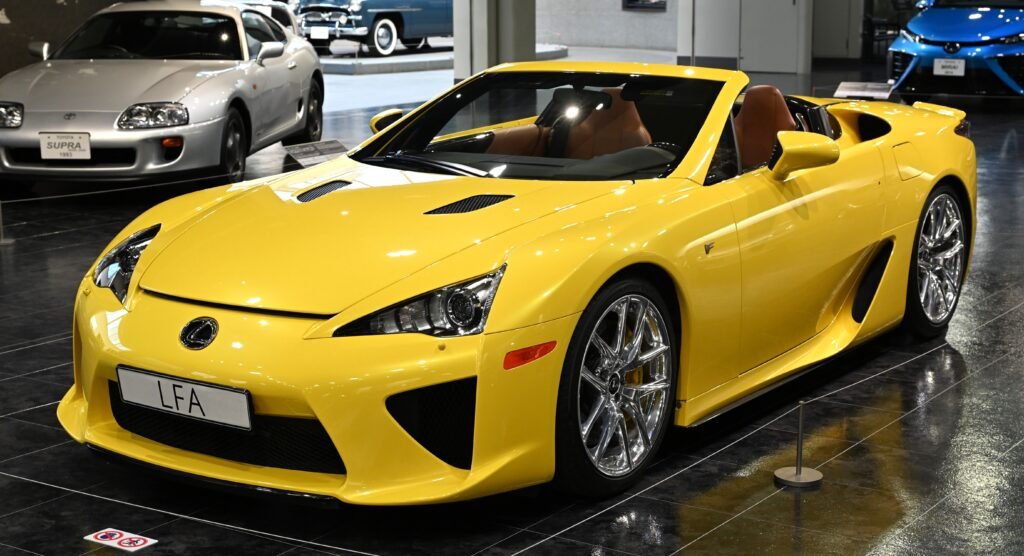
This is where the TZ gets interesting—and a little ridiculous. Lexus is positioning the cabin as a “relaxing lounge experience,” and the brand has invested heavily in noise insulation and NVH tuning. In fact, Lexus claims the TZ will be the quietest SUV in their entire lineup, quieter than even the flagship LX. Which makes the next part even weirder: the TZ features an Active Sound Control system that pipes in synthesized soundscapes tied to your throttle inputs. Lexus calls these “musical chord sequences,” but the headline feature is a drive mode that mimics the howl of the LFA V10—the company’s legendary supercar from 2010. Imagine explaining that to your family on the school run. “No honey, that’s not a real engine. It’s synthetic. From a car that costs $375,000.”
But set aside the audio theater for a moment. The actual cabin experience looks legitimately upscale. The front and second-row captain’s chairs get power ventilation and power leg rests. The second row even offers pop-up ottomans for extra lounging. The third row seats are billed as “sofa-like,” which in Lexus speak probably means they’re actually comfortable—at least for kids and smaller adults. A 14-inch touchscreen dominates the dash alongside a 12.3-inch digital instrument cluster. Hidden touch controls replace the Toyota’s physical switch bank, and materials lean into the sustainability angle with bamboo inserts and bio-based UltraSuede upholstery. A 21-speaker Mark Levinson audio system, panoramic sunroof, soft-close doors, and configurable ambient lighting round out the spec sheet. Wireless Apple CarPlay and Android Auto are standard, along with built-in navigation and Wi-Fi with 5G connectivity.
Power, Range, and the Missing Details
The TZ ditches any pretense of being a light, efficient EV. It’s powered exclusively by a dual-motor all-wheel-drive system producing 402 horsepower and 369 lb-ft of torque. That’s more power than the Toyota bZ Highlander offers in its strongest configuration, which makes sense given Lexus’s positioning. Two battery packs are available: a smaller 77-kWh unit and a larger 96-kWh pack. Lexus claims approximately 300 miles of range with the bigger battery, which is respectable for a three-row EV but not class-leading.
Charging times are competitive: Lexus says you can go from 10 to 80 percent in about 35 minutes at a 150-kW DC fast charger. An NACS charging port comes standard. The TZ can also tow up to 3,500 pounds, which is typical for mid-size EVs, though range will suffer significantly with a trailer attached. A standard Direct4 all-wheel-drive system is joined by optional dynamic rear steering for added agility—a feature that’s becoming table stakes on luxury SUVs whether you actually need it or not.
What’s conspicuously absent? Performance figures. Zero-to-60 times haven’t been released yet, and we don’t have real-world range or efficiency data. Pricing remains vague too. Lexus has only hinted at a likely base Premium trim and an F-Sport variant. A single-motor, rear-wheel-drive TZ450e variant could arrive later, but for now, the dual-motor setup is the only confirmed powertrain.
Safety, Warranty, and the EV Family-Hauler Arms Race
Lexus bundles its comprehensive Safety System+ 4.0 suite as standard equipment. That includes automated emergency braking with pedestrian detection, adaptive cruise control with lane centering, and lane-keep assist. Optional features like automatic lane-change assist, rear pedestrian detection, and traffic-jam assist are available. The warranty structure is reassuring: a four-year/50,000-mile limited warranty, a six-year/70,000-mile powertrain warranty, and a best-in-class eight-year/100,000-mile battery warranty. One year of complimentary scheduled maintenance is included.
The TZ’s arrival marks Lexus’s serious commitment to electrifying its three-row segment. Toyota’s bZ Highlander proved there’s demand for electric family haulers, but Lexus is betting that luxury buyers will pay a premium for silence, comfort, and yeah, fake V10 soundtracks. Whether that translates to real sales against the Rivian R1S, Kia EV9, and upcoming three-row competitors remains to be seen. The TZ hits dealerships by the end of 2026 as a 2027 model.
- The 2027 Lexus TZ is a three-row luxury EV SUV with 402 hp dual-motor AWD and 300-mile range on the larger 96-kWh battery.
- It shares its platform with the Toyota bZ Highlander but adds 2 inches of length, reworked styling, and a much nicer interior with bamboo and recycled materials.
- The cabin features an Active Sound Control system that can synthesize a fake LFA V10 engine note, making it the weirdest feature on any family EV.
- Charging from 10–80% takes about 35 minutes on a 150-kW DC fast charger; towing capacity is rated at 3,500 pounds.
- Pricing and trim details are still TBA, but expect Premium and F-Sport variants; a single-motor variant may follow later.
Sources: Car and Driver · Carscoops · InsideEVs · Motor1