The 2027 Audi SQ7 Is a 591-HP Family SUV Built for People Who Think Minivans Are Boring
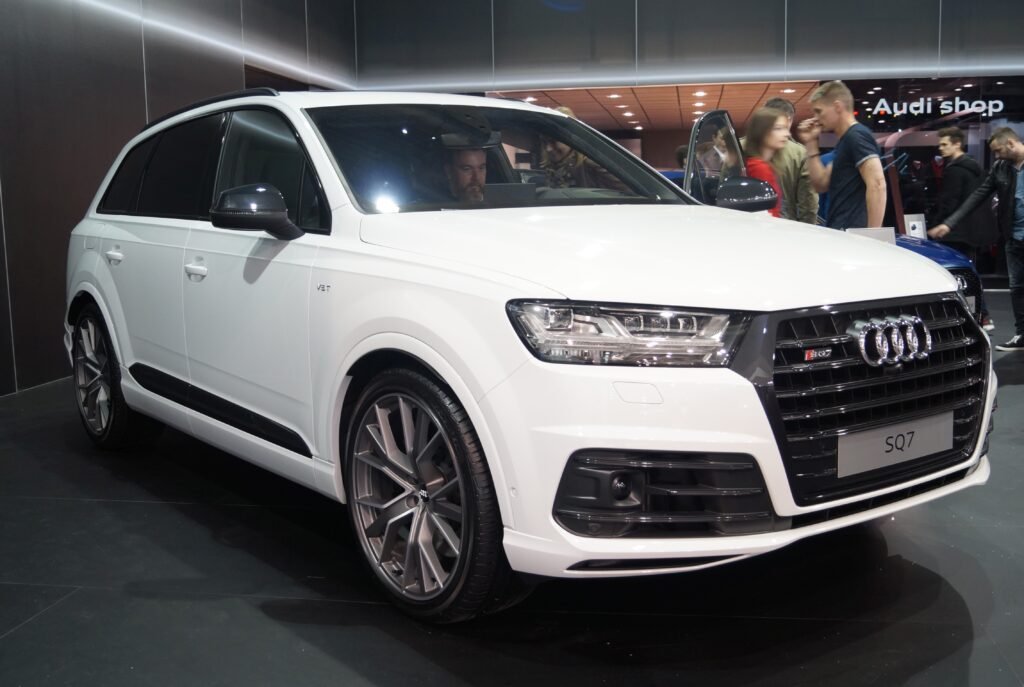
Audi just redesigned the SQ7 for 2027, and it’s arrived ready to prove that family transportation doesn’t have to be boring. This is a three-row SUV powered by a 591-horsepower twin-turbocharged 4.0-liter V-8—that’s 162 more horses than the standard Q7’s turbocharged six-cylinder—and it hits 60 mph in a claimed 3.7 seconds. For context, that’s quicker than most sports cars most people will ever own. It’s also absolutely ridiculous for an SUV with a third row of seats.
This is the second generation of the SQ7 nameplate, and Audi clearly didn’t half-ass it. The whole package sits on an adaptive air-spring suspension system designed to balance highway comfort with corner-carving capability. It’s the same dual-personality formula that rivals like the BMW X5 M and Porsche Cayenne GTS have been chasing, except the SQ7 gets it in a package designed for actual families—if those families happen to have six-figure budgets and a taste for velocity.
The Engine and Performance Story
That V-8 is the headline here, and for good reason. The engine pairs with an eight-speed automatic transmission and all-wheel drive as standard, meaning power gets distributed intelligently in all conditions. The claimed 3.7-second 0-60 time puts it in genuinely quick territory—not supercar fast, but faster than you’d reasonably need an SUV to be. The real-world performance will matter more once testers get behind the wheel, but on paper, this thing should feel seriously quick off the line and through mid-range acceleration.
Interestingly, the SQ7 doesn’t absolutely demolish its key competitors in a straight line. The Land Rover Range Rover Sport SV and Cayenne GTS are in the same ballpark for acceleration, so this isn’t a case of Audi lapping the field. What matters is that the SQ7 achieves this performance while maintaining luxury-car manners and three-row seating. That’s the actual draw—not that it’s the fastest, but that it does everything well simultaneously.
On the suspension front, buyers get a standard adaptive air-spring setup, with an optional sport adaptive air-spring system available that lowers the ride height by 1.2 inches. Pair that with standard bigger brakes, available summer tires, and optional 23-inch wheels, and you’ve got a recipe for something that could genuinely corner like it’s half this SUV’s size.
The Interior and Tech Overload
Step inside, and Audi has absolutely covered the dashboard in screens. We’re talking three separate digital displays: a 14.5-inch central touchscreen, an 11.9-inch digital gauge cluster, and a 12.3-inch passenger touchscreen. It’s a lot, and depending on your tolerance for digital interfaces, it’s either brilliant or exhausting. The latest version of Audi’s MMI software controls most functions, including—yes, annoyingly—the direction of airflow from the vents, so expect some menu diving on longer drives.
Wireless Apple CarPlay and Android Auto are standard, as is Bluetooth and integrated navigation. Audio duties go to a 16-speaker Bang & Olufsen stereo by default, with an optional 22-speaker setup available for audiophiles. The cabin itself leans heavily into sportiness, but Audi hasn’t abandoned comfort—leather upholstery is standard and comes in multiple colors, including a deep Baikal Blue that actually looks classy rather than gimmicky.
For practicality, the SQ7 offers a three-seat bench in the second row standard, with optional captain’s chairs if you want to sacrifice one passenger for a cleaner center console. Adults should fit fine back there. The third row, however, is honestly a kids-only zone—it’s tight. With all three rows in place, you get 15.2 cubic feet of cargo space, which is average for the segment. Drop the third row, and that expands to 42.9 cubic feet, which is actually useful for weekend trips or gear hauling.
The Practical Stuff You Actually Need to Know
Towing capacity sits at 7,700 pounds—the same as the standard Q7, and more than you can pull with the Range Rover Sport SV or Cayenne GTS. That’s respectable for an SUV in this class, though realistically, most SQ7 buyers aren’t shopping for towing capacity; they’re shopping for performance.
Safety features include the expected lineup: automated emergency braking, lane-keeping assist, and adaptive cruise control come standard. Optional upgrades include a self-parking feature and a 360-degree exterior camera system. For detailed crash-test results, NHTSA and the Insurance Institute for Highway Safety will have the full breakdown once testing is complete.
The warranty is class-typical: four years or 50,000 miles on the limited warranty and powertrain, with three years or 30,000 miles of complimentary maintenance. That matches what BMW and Volvo offer, so no surprises there.
The Real Question
The 2027 SQ7 is fundamentally a car for people who refuse to choose between performance and practicality. It’s not the fastest performance SUV you can buy, and it won’t have the highest cargo space. But it’s the best at being all three things at once: genuinely quick, genuinely comfortable, and genuinely spacious. That’s not a compromise; that’s the entire point.
The estimated six-figure price tag is steep, obviously. If that sounds like overkill, the standard Q7 exists as a slightly less insane alternative—same SUV, same three rows, same luxury, minus the V-8 and the performance. But if you’ve got the budget and you think hybrid family cars are cowardly compromises, the SQ7 is basically built for you.
- The 2027 Audi SQ7 pairs a 591-hp twin-turbo V-8 with three-row seating and a $100K+ price tag.
- It hits 60 mph in 3.7 seconds and includes adaptive air-spring suspension with optional sport tuning.
- The cabin is loaded with three digital displays, wireless Apple CarPlay/Android Auto, and optional Bang & Olufsen audio, though tech controls are menu-heavy.
- It offers 15.2 cubic feet of cargo with all seats up, 42.9 with the third row folded, and 7,700-pound towing capacity.
- Standard four-year/50,000-mile warranty and three years of complimentary maintenance mirror competitors like BMW and Volvo.
Sources: Car and Driver