The 2026 Alfa Romeo Tonale Finally Justifies Its Price Tag
For years, the Alfa Romeo Tonale carried one of the automotive world’s cruelest burdens: being a genuinely pretty car that didn’t drive well enough to justify its name. It had the badge, the styling, even the heritage—but when you actually drove it, you kept waiting for the good part to show up. Well, congratulations to Alfa Romeo, because the 2026 model year finally solved that problem.
The numbers tell a story that needed telling. When Carscoops tested the previous-generation PHEV, it was quick enough but came with a $60,000 price tag that made your brain hurt. Fast forward to today, and the new top-spec Sport Speciale sits at roughly $45,000—a staggering $15,000 reduction that fundamentally changes the equation. The PHEV is gone from the American market, replaced by a simpler, lighter, and far more purposeful turbocharged gasoline engine. The Stelvio, Alfa’s larger crossover sibling, is aging like milk. The timing couldn’t be better.
Looking the Part, Finally Acting It
The 2026 refresh isn’t a complete redesign—Alfa didn’t need one. The Tonale was never ugly; it just felt like it was apologizing for existing. The new front fascia sharpens things up considerably. The grille, now a direct homage to the 33 Stradale supercar, commands more presence without tipping into overwrought territory. The updated rear lighting is genuinely striking after dark. It’s the work of a design team that finally believes in what it’s building.
Those three-hole “phone dial” wheels are still one of the segment’s best details, looking almost carbon-fiber from twenty paces despite being regular metal. There’s character here—the kind that makes people glance twice in a parking lot. And then there’s the quirks. The rear doors have this odd little upward jut of glass near the roofline that will absolutely smack you in the face if you’re not careful. It’s the sort of thing that screams “Alfa Romeo designed this,” for better or worse.
The Interior Walk a Fine Line
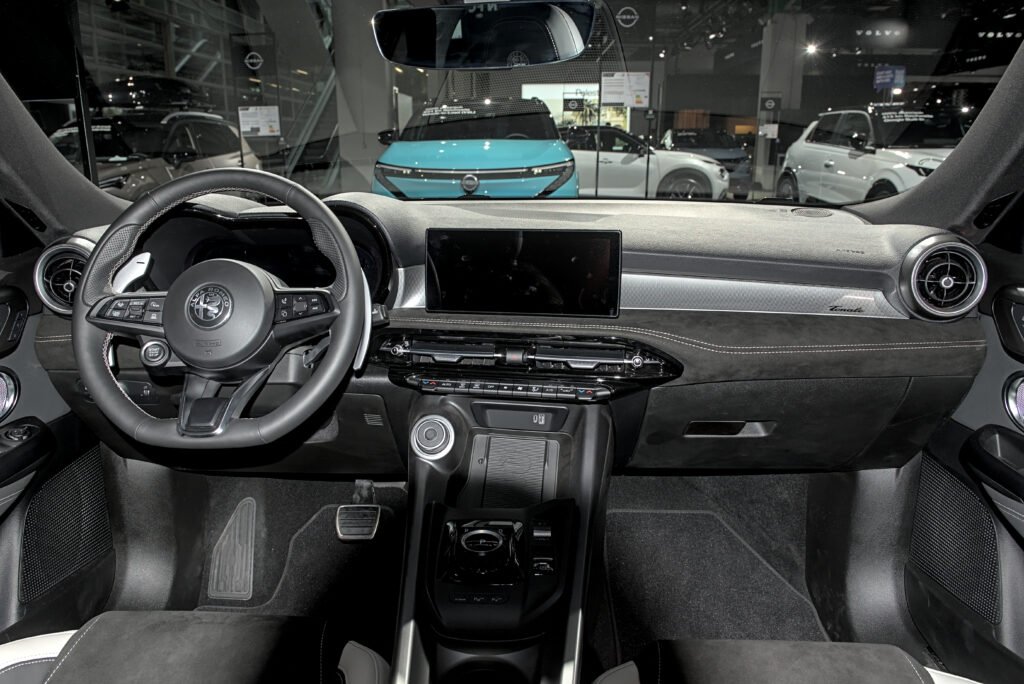
Step inside and you’ll find a cabin that refuses to play it safe. The front seats are genuinely excellent—comfortable on long hauls, supportive enough when you’re pushing, and they feel like they belong in something with real pretense. The space is modest but never cramped, and Alfa has sprinkled in details that punch well above the price point.
Those giant aluminum paddle shifters remain the MVP of the interior. Not plastic pretenders—actual metal. Every brush of your fingers against them creates this small sense of occasion. Equally commendable: Alfa embossed its logo into the wireless charging pad, kept physical climate controls (an increasingly radical choice in 2026), and designed an infotainment system that prioritizes usability over screen size. It’s refreshingly honest.
The downside is real, though. Some switchgear feels noticeably cheaper than the rest of the cabin suggests. The shifter lacks the heft you’d expect. Upper-dash plastics don’t exactly whisper “Italian luxury.” But here’s the thing—this isn’t a $70,000 vehicle. At $45,000, context matters enormously. Most buyers will assume an Alfa costs more than it actually does, and the badge still carries that premium perception even when the window sticker tells the truth.
Rear passengers get a tougher deal. Legroom is acceptable at best, and the aggressively sloped roofline creates a cave-like atmosphere that taller occupants will notice immediately. Storage is 27 cubic feet—adequate for real-world use but not exactly cavernous. It’s a trade-off made in service of proportion and handling, and Alfa committed to it fully.
Where the Magic Actually Happens
The engine is a 268-horsepower 2.0-liter turbocharged four-cylinder producing 295 lb-ft of torque. On paper, that’s not jaw-dropping. In practice, it’s perfectly adequate—and when paired with the rest of the chassis, it becomes something special. The previous PHEV was technically quicker, but you’d need a stopwatch to prove it. This naturally aspirated version feels noticeably lighter and eager, which matters more than raw numbers suggest.
The steering is where Alfa’s engineering philosophy becomes clear. Accurate, direct, and unusually communicative for a compact crossover, it never feels numb or disconnected. The front end goes exactly where you point it. The adaptive dampers are a genuine gift—they settle the chassis when you want comfort but stiffen up when you’re pushing harder into corners. Push genuinely hard, and the Tonale feels flat and composed. Back off, and it remains perfectly civil around town.
But then you discover those paddle shifters actually do something. Flip into manual mode and suddenly this becomes genuinely engaging. The transmission responds with speed, shifts feel satisfying, and those metal paddles transform from a tactile gimmick into a legitimate control interface. You start taking downshifts just because you can. You start inventing routes home that add time to your commute. You stop thinking about the Tonale as transportation and start thinking of it as entertainment.
The fuel economy doesn’t punish you for all this personality—EPA figures hover around 24 mpg combined for the AWD version, which is perfectly reasonable for a car making nearly 270 horsepower. That’s not record-breaking, but it’s honest and achievable.
There is one legitimate flaw: at low speeds, the nine-speed transmission occasionally seems genuinely confused. It hunts. It searches. Light driving through neighborhoods or traffic can feel clunky, like the gearbox forgot what it wanted. Put your foot down and the issue mostly disappears. Drive gently and it feels like the transmission is a teen driver checking their phone. It’s a weird quirk that suggests the software tuning could use another pass.
The Price Finally Makes Sense
This is where the 2026 model genuinely changes the game. The previous Tonale we tested wore a $60,000 window sticker, and at that point you were shopping dangerously close to Stelvio territory, entry-level German luxury, and other crossovers that offered more space, more power, or more badge prestige. The math was uncomfortable.
At $45,000 for the Sport Speciale—with lesser trims available around $40,000—the Tonale suddenly competes against the BMW X1, Audi Q3, and the closely related Dodge Hornet. In that context, it doesn’t feel wildly overpriced. Honestly, most buyers will assume it costs significantly more. The Alfa badge still carries that premium perception, and now the price doesn’t immediately undermine it.
The 2026 Tonale is what the original should have been—a small, engaging, genuinely charming crossover that doesn’t ask you to compromise on driving experience to own something with Italian DNA. It won’t outrun a turbocharged German competitor. It won’t outspace a mainstream three-row. But it will make you want to take the long way home. And at $45,000, that’s exactly enough.
- The 2026 Alfa Romeo Tonale Sport Speciale costs $45,000—$15,000 less than the previous PHEV.
- Naturally aspirated 268-hp 2.0L turbo replaces the PHEV; lighter, more eager, achieves ~24 mpg combined.
- Sharp steering, responsive paddle shifters, and adaptive dampers make this compact crossover genuinely fun to drive despite modest horsepower.
- Interior mixes real details (aluminum paddles, physical climate controls) with budget materials, but punches above its price point.
- The real win: Alfa finally priced it where the badge stops feeling expensive and starts feeling like a genuine value.
Sources: Carscoops