The 2027 Porsche Taycan Proves EVs Can Still Be Porsche
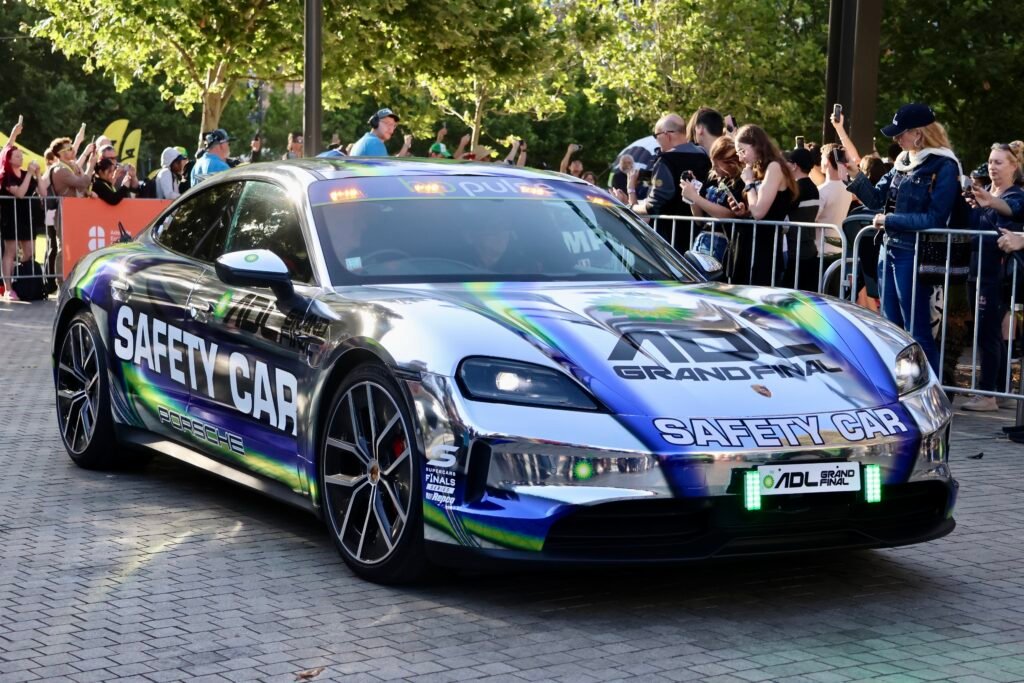
The 2027 Porsche Taycan is still doing what matters most: it feels like a Porsche. No engine rumble, no flat-six vibration through your spine—just that same surgical precision and instantly responsive handling that made the 911 legendary, now electrified.
That’s not nothing. In a world where EV acceleration often feels like the only metric that counts, the Taycan proves that a nameplate doesn’t have to sacrifice its identity on the altar of battery chemistry. The steering talks. The suspension is taut. The thing corners like it’s on rails. In real-world testing, Car and Driver measured a Taycan 4S hitting 60 mph in 3.1 seconds and delivering 330 miles of highway range—both figures that beat EPA estimates.
But let’s be honest: this is a Porsche, which means you’re paying luxury tax before you even check the options list.
What’s Actually New for 2027
Porsche rolled out three meaningful changes for this model year, and exactly one of them is genuinely clever. The headliner is E-Shift, a new feature that lets you row through eight simulated gears using steering-wheel-mounted paddle shifters. When activated, a tachometer pops onto the digital gauge cluster and artificial engine noise gets pumped into the cabin. Is this necessary? Absolutely not. Does it work? Yeah, it actually does—the psychological feedback loop of “shifting” helps some drivers feel more connected to the driving experience, even if the two-speed transmission is doing all the actual work underneath.
The second change is practical: all Taycans now come standard with the larger 105-kWh Performance Battery Plus, which used to be an expensive option. That’s the kind of move that improves the baseline experience without requiring a press release. The third tweak is smaller—the passenger-side DC fast-charging port is now NACS native, and the infotainment software now supports widget customization. Useful stuff, nothing that moved the needle.
Power and Performance: A Lineup for Every Budget (Sort Of)
The beauty of the Taycan is that there’s a real range of capability across the trim hierarchy. The base rear-wheel-drive model makes 402 horsepower, which is plenty for most mortals. Jump to the Taycan 4 and you get dual motors for 429 hp. The 4S bumps that to 536 hp. The GTS reaches 690 hp. The Turbo S maxes out at 938 hp with launch control engaged (764 hp in normal driving). The bonkers Turbo GT tops out at 1,019 hp during launches and still makes 777 hp in everyday driving.
That last number bears repeating: 777 horsepower in normal mode. That’s four times what a base 911 produces. Yet the Taycan doesn’t feel like a one-trick drag-strip pony. The two-speed direct-drive transmission plays a critical role in both acceleration and range efficiency, while the air-spring suspension and available adaptive dampers keep everything planted through corners. The optional Porsche Active Ride active-suspension system, tested on earlier models, impressed reviewers by managing to filter out road imperfections while still limiting body roll—a difficult balance that most EVs botch.
Range and Charging: Honest Numbers, Honest Compromises
Here’s where the Taycan gets exposed. EPA estimates put the Taycan’s range between 251 and 315 miles, depending on trim and battery choice. That’s honest—nowhere near the ridiculous marketing claims some EV makers throw around—but it’s also notably less than competitors like the Lucid Air and Tesla Model S, both of which regularly crest 400 miles per charge.
Charging, though, is genuinely fast. Porsche rates the Taycan for up to 320 kW of DC charging, and in ideal conditions, you can go from 10 to 80 percent in just 18 minutes. Real-world testing showed a Turbo GT charging from 10 to 90 percent in 24 minutes. That’s as quick as this technology gets, and it matters when you’re eating cross-country miles. Highway efficiency is strong too—that Taycan 4S we mentioned earlier beat its EPA estimate in actual testing, something EVs rarely do.
Fuel economy numbers sound bonkers when they’re measured in MPGe: the Taycan ranges from 80–94 MPGe city to 78–92 MPGe highway. For context, that’s genuinely efficient even by EV standards.
The Interior: Spartan by Default, Luxurious if You Pay Up
The Taycan’s cabin is vintage Porsche—minimalist and focused, with everything angled toward the driver. The standard setup is almost aggressively simple: you get a curved 16.8-inch gauge display and two centralized touchscreens (10.9 inches on top, 8.4 inches below). That’s it. No physical buttons to speak of. Connectivity includes wireless Apple CarPlay and Android Auto, and the infotainment system now supports voice commands through Amazon Alexa.
But here’s where Porsche’s options list becomes insultingly expensive: luxury packages can add four-zone climate control, massaging front seats, heated rear seats, and auxiliary touchscreens in the passenger and rear seats. The sound system jumps from a basic 10-speaker stereo to optional 14-speaker Bose or 21-speaker Burmester setups, now with Dolby Atmos. Basically, the base cabin is a Porsche minimalist statement, and the optioned-out version is a rolling luxury suite—just at prices that will make your accountant weep.
Practicality is the real weakness. Cargo space is tight: only four carry-on suitcases fit in the trunk with seats up, though it expands to 16 with rear seats folded. The frunk holds just one carry-on. Rear legroom is compromised too, and squeezing into those low front buckets requires some athletic ability. Porsche offers a station-wagon variant called the Taycan Cross Turismo for those who need more space, but that’s a separate decision entirely.
Pricing and the Elephant in the Room
The Taycan commands a premium that’s hard to justify on a spreadsheet. It’s expensive—period. When you load up options, you’re looking at six-figure territory fast. Rivals like the Lucid Air and Tesla Model S are roomier, more practical, and offer more range per charge, often at lower starting prices. If maximum efficiency, cargo space, and value matter to you, this isn’t your car.
But that’s not really the point. The Taycan is for people who care that their EV handles like a 911, charges stupidly fast, and still wears a Porsche badge without irony. The car meets all modern safety standards, and it comes standard with automated emergency braking, lane-departure warning, and lane-keeping assist, with optional adaptive cruise and lane-centering available. The warranty is competitive for a luxury EV: four years or 50,000 miles basic coverage, eight years or 100,000 miles on the powertrain—though notably without unlimited mileage like Tesla offers.
The Verdict
The 2027 Taycan doesn’t reinvent the EV sports-car segment, and it doesn’t need to. It’s an evolution of a formula that already worked: put Porsche’s DNA into an electric package and let the driving experience do the talking. E-Shift is a gimmick that somehow works. The standard larger battery is a genuine improvement. The charging speed is still best-in-class. And the steering, handling, and overall chassis tuning remain legitimately special in a field increasingly dominated by straight-line acceleration contests.
Is it the most practical or best-value electric sedan-slash-sports-car on the market? No. Is it the one that actually feels like a Porsche? Still yes. That matters to Porsche people, and at this point, Porsche people have accepted that they pay for the name and the experience. The 2027 Taycan delivers both.
- The 2027 Taycan adds E-Shift paddle controls for simulated gear changes and makes the larger 105-kWh battery standard across the lineup.
- Power ranges from 402 hp (base RWD) to 1,019 hp (Turbo GT with launch control), with real-world 0–60 times as quick as 1.9 seconds and 330 miles of highway range on the 4S.
- EPA range estimates (251–315 miles) trail Tesla Model S and Lucid Air, but 320-kW DC charging enables 10–80% charges in 18 minutes under ideal conditions.
- Cargo space is tight, rear seating is cramped, and the options list is ruthlessly expensive—but the handling and steering precision still feel authentically Porsche.
Sources: Car and Driver