The American Car That Best Sums Us Up Isn’t What You’d Expect

America didn’t invent the car. But we turned it into a religion, a business model, and eventually, a symbol of everything we believe about ourselves—both the genius and the delusion.
Henry Ford didn’t create the automobile, but he built the machine that made them affordable for regular people. His assembly line became the blueprint that every automaker on Earth copied. Detroit became the epicenter of global automotive manufacturing. Without American innovation, the car industry as we know it simply doesn’t exist. That’s not ego—that’s fact.
So as America celebrates 250 years of existence, the question becomes unavoidable: what single car best represents what we‘ve actually become?
The Obvious Choices Fall Short
Your first instinct is probably a classic. Maybe a Model T. Perhaps a ’57 Chevy. A Corvette. Something with prestige, polish, and a place in a museum. Those cars absolutely represent what America *wanted* to be—innovative, bold, aspirational.
But they don’t represent what America *actually is* in 2026.
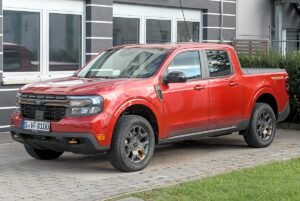
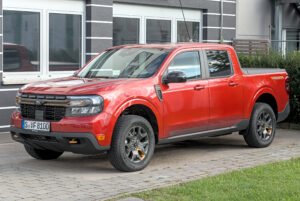
The modern truck market screams louder than any vintage icon. The F-150 has dominated American sales for decades, and Ram and Chevy fight viciously for scraps below it. These trucks are genuine machines—capable, reliable, built for real work. They’re also the most bastardized vehicles on the road.
Meet the Symbol: A Lifted F-150 with All the Trimmings
Forget the stock version. Picture instead an obnoxiously lifted F-150 with wheels that cost more than most cars, a diesel engine, and a stack exhaust pipe that serves no functional purpose except to announce its presence like a toddler screaming in Costco. Throw in an American flag fluttering from the tailgate, maybe truck nuts dangling underneath, and you’ve got your monument to American excess.
Ford makes a genuinely good truck—arguably better than what Ram or Dodge are selling right now, and certainly better than what GMC is passing off as a luxury experience. Ford has real roots in American industrial competence. That’s the irony that makes this work.
But those modifications? The $15,000 suspension lift, the tires that stick out comically past the fenders, the engine tuned to belch clouds of black smoke (“coal rolling,” as the enthusiasts call it)—that’s pure, undiluted American contradiction. We took something useful and buried it under vanity, inefficiency, and a middle finger to practical thinking.
Why This Actually Works as a Symbol
The lifted F-150 perfectly captures America’s dual nature. On one side, it’s built on genuine engineering excellence and the legacy of mass production that changed the world. On the other, it represents our spectacular talent for excess, for misplaced pride, for taking something good and destroying it in the name of personal expression.
It’s the car equivalent of a nation that put a man on the moon and then spent decades arguing about which type of moon landing actually happened. It’s innovation and delusion parked in the same driveway.
The modified truck is honest in a way that a restored Model T or a pristine Corvette simply can’t be. Those classics represent aspirational mythology. The lifted F-150 represents actual behavior—what Americans actually *do* with their freedom and resources when nobody’s watching.
The Deeper Truth
Here’s what makes this argument work: the American pickup truck became a category unto itself precisely because Americans demanded it. We didn’t inherit truck culture from Europe or Asia—we invented it. We wanted vehicles that could work hard and carry our ego simultaneously. The industry gave us exactly what we asked for.
Then we took those trucks and transformed them into rolling comedy—massive, impractical, aggressively stupid, and somehow still charming because of that commitment to the bit. That’s as American as it gets.
Ford’s connection to this particular timeline matters too. The company didn’t just succeed—it fundamentally shaped how the global economy operates. The F-150’s dominance isn’t accident; it’s the direct descendant of Ford’s original vision of accessible transportation for the masses. That we’ve turned it into a $80,000 personalization platform is hilarious and tragic in equal measure.
If America were throwing a parade celebrating 250 years of existence and wanted one vehicle to represent the whole messy experiment, this is it. Not the beautiful lie of a museum piece, but the honest chaos of what we’ve actually become. A truck that works. A truck we broke on purpose. A truck that somehow still represents American excellence, even as it embodies American excess. That’s the 250-year story in four wheels.
- The F-150 truck is the most honest symbol of America’s 250-year automotive legacy—not because it’s great, but because of what we’ve done to it.
- A lifted, diesel-powered F-150 with oversized tires and a coal-rolling exhaust represents America’s dual nature: genuine engineering excellence buried under excessive vanity.
- Ford’s legacy of mass-production innovation makes this the perfect ironic monument to American achievement—and American delusion.
Sources: Jalopnik