The 2025 Porsche 911 Carrera 4 GTS Cabriolet Proves AWD Isn’t Just for Snow
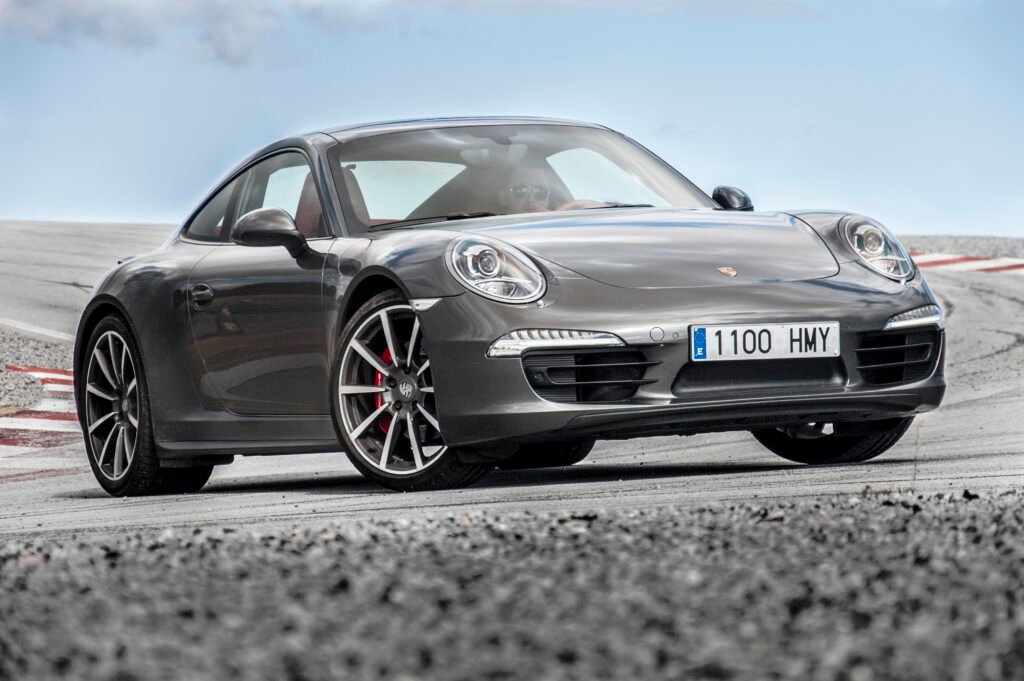
The conventional wisdom says all-wheel drive on a Porsche 911 is a snow-belt tax—something you tolerate if you live somewhere cold, not something you’d voluntarily pay for on a drop-top GTS that’ll never see a snowflake. Except Car and Driver just proved that wisdom wrong in the most direct way possible: by strapping the same driver into an RWD and AWD version of the exact same car, on the same day, in the same press fleet.
The result is genuinely surprising. That $7800 AWD premium doesn’t just give you marginally more sure-footedness when things get slippery. It fundamentally changes how the car performs when you’re pushing it hard—and not always in the ways you’d expect.
The Setup: A Nearly Perfect Test
Both cars were 2025 911 GTS Cabriolets with near-identical specs. The rear-drive version started at $180,195; the Carrera 4 GTS at $187,995. Identical powertrains (a turbocharged 3.6-liter flat-six with hybrid assist), identical tires (Goodyear Eagle F1 SuperSport R-compounds), identical driver, identical track. The only meaningful differences were color, interior trim, and the AWD system itself. Car and Driver even caught a fuel-tank discrepancy (the larger 22.1-gallon tank isn’t compatible with the front prop shaft), so the real weight penalty of all-wheel drive is closer to 100 pounds, not the initially measured 67.
This is the kind of apples-to-apples comparison that almost never happens. And it matters.
Acceleration: AWD Wins, Full Stop
Porsche claims both cars hit 60 mph in 3.0 seconds. That’s corporate fiction. The AWD Carrera 4 GTS crushed that claim, rocketing to 60 in 2.6 seconds versus the RWD’s 2.9 seconds. The gap widens to 100 mph: the 4 managed it in 6.5 seconds; the rear-driver took 6.7.
Quarter-mile trap speeds were identical at 129 mph, but the Carrera 4 got there in 10.8 seconds versus 11.0. That’s not a rounding error—that’s the front tires actually doing something useful instead of just looking pretty. Under hard acceleration, the additional weight on the front axle (the AWD system adds roughly 80-100 pounds up front) creates more mechanical grip, and the PDK dual-clutch transmission has better bite to feed that power to pavement.
Cornering: The Real Magic
But here’s where things get interesting. Braking was essentially identical—both stopped from 70 mph in 139 feet. AWD doesn’t help you stop, as anyone who’s hydroplaned knows. What it does is change how the car turns.
The Carrera 4 GTS managed 1.05 g on the 300-foot skidpad versus 1.02 g for the rear-driver. That’s a 3 percent improvement—seemingly small until you’re actually driving it. The extra weight on the front axle (measured at 37.2 percent for the AWD versus 36.6 percent for the RWD) changes the balance entirely. Turn-in is more confident, the front end bites harder, and there’s a palpable sense of the car being welded to the road rather than negotiating with it.
For a convertible, this matters. Droptops are chassis compromises—less torsional rigidity than their hardtop siblings. The additional front-end mass and the all-wheel-drive system’s geometry actually seem to counteract some of that flex. The 992-generation 911’s engineering has always been clever about distributing loads, and the AWD variant leans into that.
The Ride Quality Problem (That Has Nothing to Do With AWD)
Here’s where the review gets honest: the GTS might be too damn stiff. Both versions exhibit excellent body control and zero perceptible flex, but the suspension tuning is punishing on anything rougher than fresh asphalt. Car and Driver notes that the GTS suspension delete—a no-cost option that swaps for softer Carrera S springs and allows a 0.4-inch ride height increase—might be the move if you actually want to enjoy this car on real roads.
That said, the front-axle lift system ($2980) is genuinely clever, with GPS memory so you don’t have to manually engage it at your favorite speed bump every time. The convertible top is where Porsche got everything right: seamless when up, quick to drop (12 seconds at speeds up to 31 mph), and it looks intentional either way.
The Efficiency Trade-Off Nobody Asked For
The one concrete knock against choosing AWD? The larger fuel tank can’t be paired with the all-wheel-drive system. That drops the Carrera 4’s highway range to 380 miles instead of 500—a meaningful difference if you’re trying to span the Nevada desert without a fill-up. During testing, the car averaged 22 mpg, which is legitimately impressive for something with 532 horsepower and the aerodynamic profile of a brick.
The EPA rates it at 19 mpg combined (17 city/23 highway), and highway cruising should easily exceed that 23-mpg number. So the real-world efficiency hit is minimal, but the range penalty is real.
So Is It Worth It?
The industry’s narrative is that AWD is a winter luxury, a safety net for people who live where it rains sideways. But Car and Driver’s back-to-back test reveals something Porsche has known for years: all-wheel drive actually makes a 911 better at what it’s designed to do—go fast and turn hard.
Three-hundredths of a second might seem trivial. But when you’re paying north of $180,000 for a sports car, those hundredths are the entire point. Add the improved cornering balance, the more planted feel through direction changes, and the psychological confidence that comes with additional grip, and $7800 starts looking like a bargain. That’s less than the cost of a single option package. On a car this expensive, it’s borderline negligible.
The real choice isn’t whether to buy AWD. It’s whether you want the sharper, more responsive front end that comes with it, or whether you’re committed to the analog purity of rear-drive dynamics. If you can afford a $208K convertible, you can probably afford both versions and make an educated choice. For everyone else: the Carrera 4 GTS is the better all-around machine. The snow thing is just a bonus.
- 2025 Porsche 911 Carrera 4 GTS Cabriolet hits 60 mph in 2.6 seconds vs. 2.9 for the rear-drive GTS—real-world advantage despite identical horsepower.
- All-wheel drive adds 100 pounds and costs $7800, but improves skidpad grip to 1.05 g from 1.02 g and transforms turn-in feel and front-end bite.
- Trade-off: larger fuel tank incompatible with AWD system, dropping highway range to 380 miles instead of 500; GTS suspension may be too stiff regardless of drivetrain.
Sources: Car and Driver